
Releases from Missouri DOC Institutions
No Missouri Department of Corrections prison was verified as physically located in Shelby County. MODOC matters here when a Shelby County Jail movement record shows commitment or transfer to state custody, or when a person with a Shelby conviction is held in a state institution elsewhere. The statewide search must not be presented as a local jail roster.
A person can leave a MODOC institution through parole, conditional release, final discharge, transfer to another state or federal custodian, or another corrections event. Parole and conditional release place the person outside the prison while MODOC authority continues. Final discharge ends the represented supervision. A transfer merely changes the institution or custodian.
| State event | Physical result | Best confirmation |
|---|---|---|
| Parole | Leaves prison under Board conditions and MODOC legal custody | Active status, field assignment, Board decision |
| Conditional release | Begins the supervised portion of a qualifying sentence | MODOC release date, status, and event |
| Institution transfer | Moves within corrections custody | Assigned place and event history |
| Transfer to another agency | Leaves MODOC but remains with a receiving custodian | MODOC event plus receiving-agency record |
| Final discharge | Ends the represented MODOC supervision | Historical file, completion reason, order or certificate |
If Shelby County Jail delivered the person to MODOC, the county movement date is not a community-release date. It proves only that Shelby custody ended and state custody began. Intake and data processing can delay the active state result. Preserve the sheriff's receiver and transfer date until MODOC displays the new assignment.
Missouri DOC Active Offender Search
The MODOC Offender Search covers active offenders, including active probationers and parolees. It does not provide information on discharged offenders, and some records may be omitted for safety, security, or confidentiality. That design makes it useful for a state prisoner or someone released from prison under active supervision, but incomplete as a lifetime history.
Search by DOC ID when possible. It is the lifetime unique identifier in MODOC data. If only a name is known, use the first and last name, test documented aliases, and compare the public identifiers. A CAPTCHA precedes results. Save the page's data timestamp, the search time, status wording, and assigned place.
- Confirm that the Shelby case led to MODOC custody through the county movement record or judgment.
- Open the MODOC search and enter the DOC ID. Use name and aliases only when the ID is unavailable.
- Compare the result carefully. Read status, assigned place, offenses, and sentence context together.
- Determine whether the assignment is institutional or field-based. A field assignment may support physical prison release under supervision.
- Copy each date with its exact label. Minimum, maximum, conditional, presumptive, and actual event dates answer different questions.
- If the person is missing after a reported transfer, allow for intake delay and contact Offender Inquiry or the assigned caseworker.
The official state offender-search source is shown below.
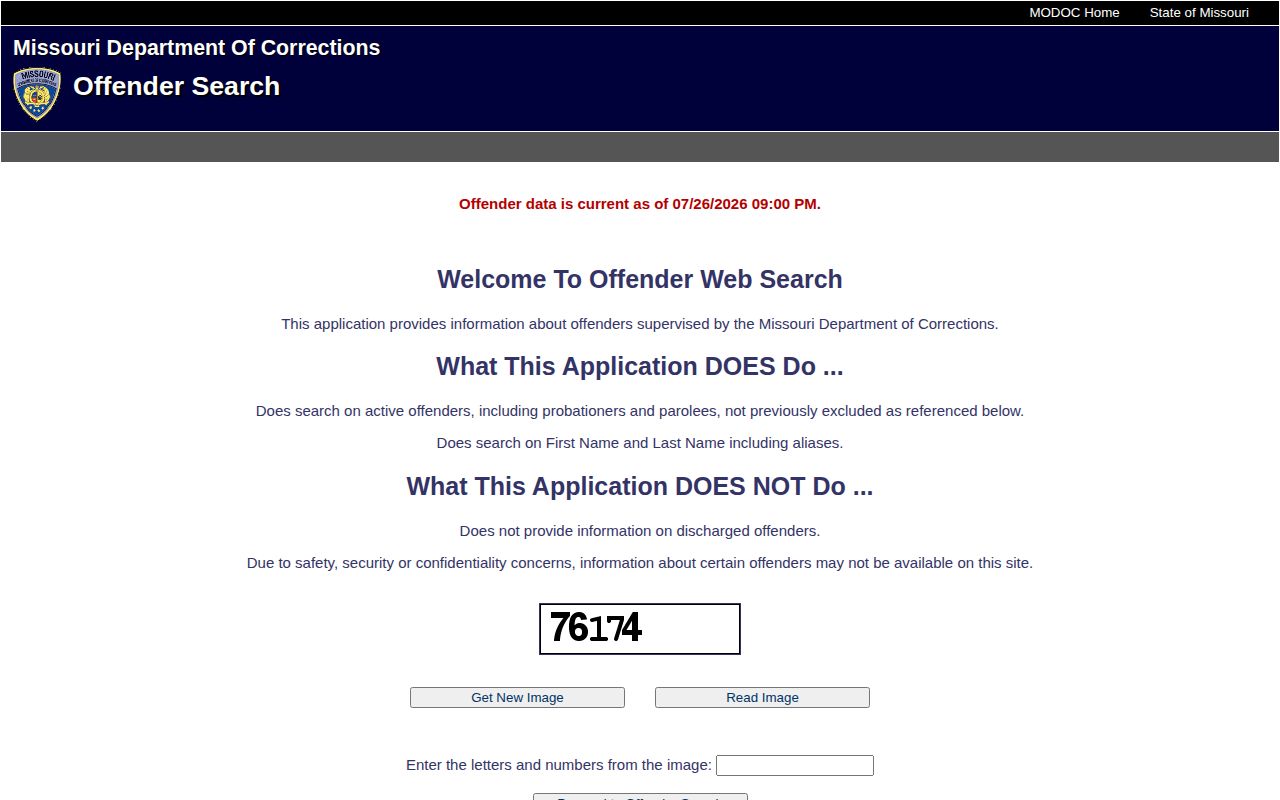
The search form identifies the active system and its fields. It does not turn a future sentence date into proof of release.
Missouri DOC Release Data Fields
The MODOC Sunshine page publishes downloadable data and field documentation. It can be stronger than the interactive screen when a record has several sentences or the active result is terse. The public file may contain one row per charge or sentence and several rows for one person. A field must be read at its row level before a broader conclusion is made.
| Field or term | Meaning and limit |
|---|---|
| DOC ID | Lifetime MODOC identifier used to keep same-name records apart |
| $PC | Sentence minimum release date on the associated active sentence |
| $PD | Sentence maximum release or expiration date for that sentence row |
| $SCF = Y | The associated sentence row is completed, not necessarily every sentence |
| Concurrent/consecutive indicator | Shows whether sentence terms overlap or run in sequence |
| F/I location function | Helps distinguish field supervision from an institutional assignment |
| Event | Can describe receipt, release, transfer, discharge, and other corrections changes |
| Custody Completion Reason | The stated ground for release from custody or supervision |
Special date values for life, indeterminate or interstate cases, and assessment records must not be printed as ordinary dates. Multiple rows also require reconciliation. Choosing the earliest `$PC` and calling it the person's overall release date can be wrong when another consecutive sentence remains active.
The official MODOC field definitions pictured here identify the minimum, maximum, and completion fields used in a precise review.
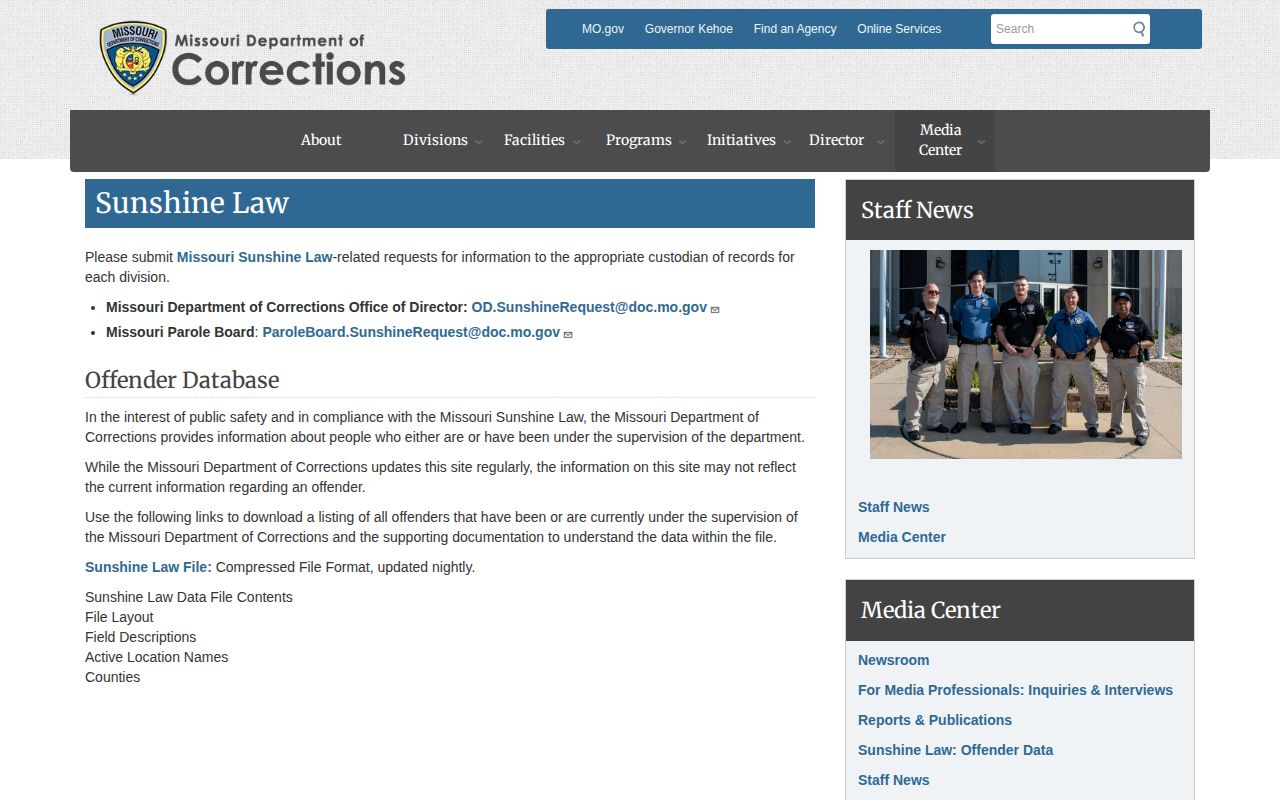
The documentation supplies the field meaning. An actual event history is still needed when the question is whether release or discharge occurred.
Note: A completed sentence flag belongs to one row and does not prove that all MODOC custody or supervision ended.
Missouri DOC Sentence Date Limits
Missouri exposes several future dates rather than one universal projected release date. MODOC uses sentence minimum and maximum release dates, a minimum release date associated with conditional release, and a presumptive parole release date. The presumptive date is tentative and depends on appropriate institutional conduct and an acceptable release plan.
Section 558.011 generally divides qualifying terms of years into incarceration and conditional-release components, subject to exclusions. The conditional part is generally the final one-third for terms of nine years or less, three years for terms over nine through fifteen years, and five years for terms over fifteen years. Conditional release remains supervised and does not cancel the whole sentence.
Section 558.019 adds minimum prison terms. Dangerous-felony cases generally face the statutory 85 percent minimum or the specified age-and-service alternative. Other prior-commitment percentages can apply in the circumstances listed by law. These thresholds affect eligibility. They do not promise release on the first eligible day.
Jail credit, concurrent and consecutive sentences, offense-specific minimums, amendments, Board action, authorized conduct consequences, warrants, and detainers can change the result. Preserve the official label. After a date passes, look for the actual MODOC event rather than silently turning a projected milestone into history.
Missouri DOC Release Under Supervision
The active search is especially useful after parole or conditional release because it includes active parolees. Read the `F/I` indicator and assigned place to distinguish a field assignment from an institution. MODOC may publicly confirm whether the person is supervised, the officer and office location, custody or bond status, a parole or conditional-release date, and the Board release decision.
Physical prison release does not end MODOC legal custody. Section 217.690 keeps a parolee subject to Board orders. A violation warrant under section 217.720 can lead to detention and a later decision to continue, modify, or revoke release. The careful description is “released from prison under supervision,” followed by the source date.
A parole hearing is not release. The official hearing process says a decision normally takes eight to twelve weeks. A panel may set a future date or another hearing. No public Shelby County calendar of named parole cases or searchable person-by-person Missouri decision database was verified. Use the actual Board notice and do not convert “eligible,” “heard,” or “presumptive” into “released.”
For a fuller explanation of the field office, warrant, and discharge distinctions, the Shelby County Post-Release Supervision page follows the active status beyond prison release.
Missouri DOC Historical Discharge Search
The active portal is the wrong tool after final discharge. MODOC's nightly Sunshine data covers people who currently are or have been supervised, with records reaching as early as 1974. Search the lifetime DOC ID, then reconcile all sentence rows, completion flags, minimum and maximum dates, assigned-place history, and events.
MODOC warns that the public download is working-file data and gives no representation of completeness or accuracy. For a definitive finding, request the event history, custody-completion reason, actual discharge date, release type or order, assigned place, and completed flag. Section 217.730 authorizes a final Board order and certificate of discharge in applicable parole or conditional-release cases.
Earned compliance credit under section 217.703 reduces eligible supervision, not prison time. Qualifying compliant cases can receive thirty days of supervision credit for a full compliant calendar month, subject to the statute. An absconder does not earn that credit during the period described by law. It should never be called county jail good time.
A durable discharge statement names the exact MODOC event, completion reason, date, and record source. If the record conflicts with an older active result, preserve both query dates and ask the corrections custodian for clarification.
Missouri DOC Records and Contact
MODOC records are subject to Chapter 610 with exceptions. Section 217.075 protects medical information, otherwise closed information, and internal institutional-security material among other limits. Ask for the open portion and use the division-specific custodians listed on the Sunshine page.
Missouri Department of Corrections
Offender records and inquiry
MODOC contact and offender inquiry
MODOC Sunshine records
Office of Victim Services notifications
573-526-6516
victims@doc.mo.gov
Provide the correctly spelled full name, inmate number, date of birth, and other lawful identifier available. General inquiry can address search information and policy, while offender-specific status questions may need the institutional caseworker or assigned field officer. Do not request protected treatment, health, victim, or security material.
When the first event was a Shelby County transfer, keep the sheriff movement entry with the MODOC result. The county record proves who received the person. The state record proves later incarceration, release under supervision, transfer, or discharge. The two records describe different stages.
About Missouri DOC Institutions
Missouri Department of Corrections institutions are state prisons for people under state corrections authority. They are not Shelby County Jail, and none was verified as physically located in Shelby County. A Shelby County conviction or jail transfer can connect a person to the statewide system without creating a local MODOC facility.
Start with the custodian the person actually left. For state prison, use MODOC status, sentence fields, Board action, field assignment, and historical discharge data. For county jail, use the sheriff movement entry and Case.net. For a federal prison, use BOP. The Shelby County released-inmate verification path helps identify which record belongs in the final packet.
Note: Exit from a Missouri prison can begin supervision or another custody transfer, so it is not automatically final discharge.